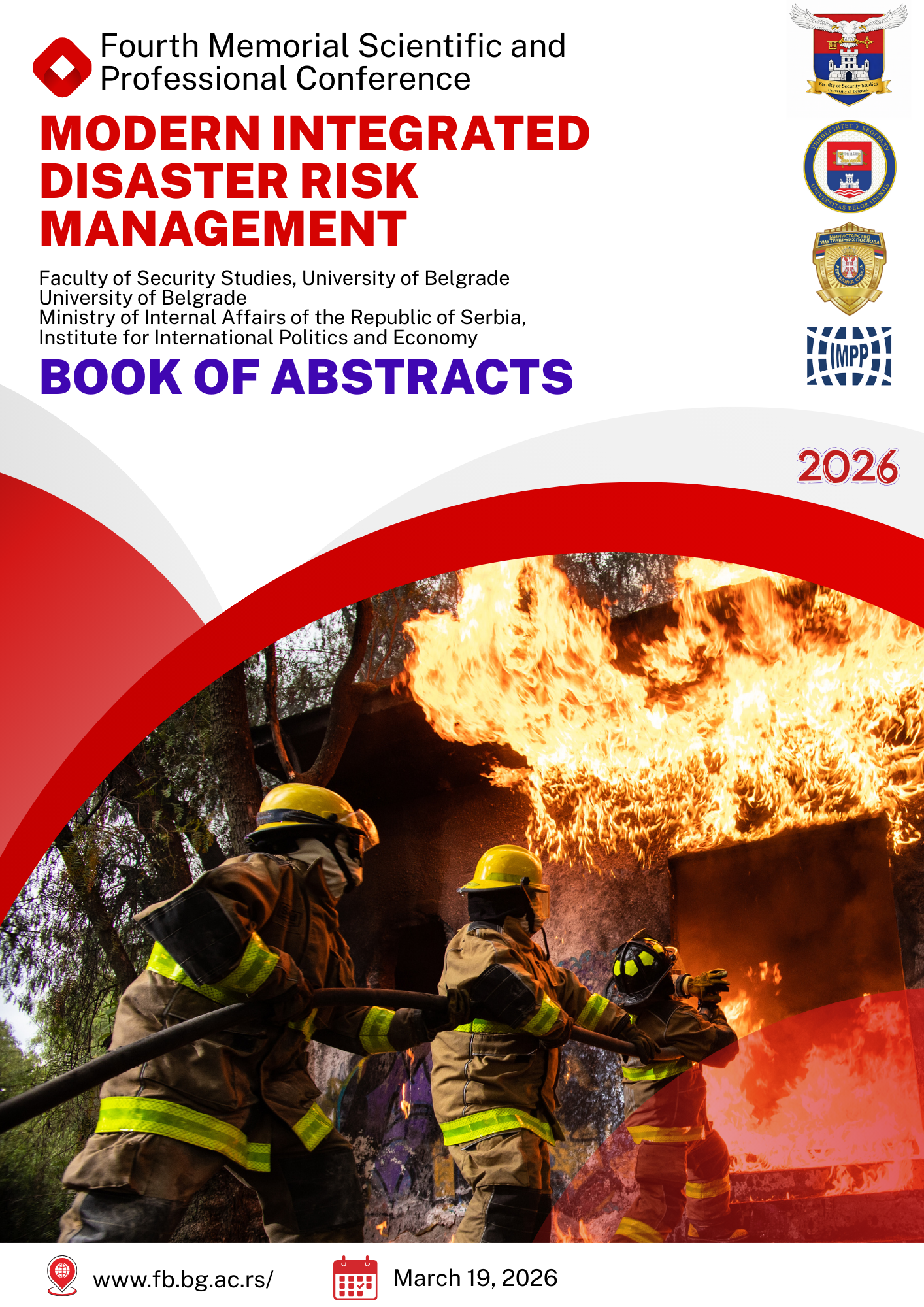
The importance of the Faculty of Security in the education of future experts in modern integrated risk management
Keywords:
ntegrated risk management, fire protection, occupational safety and health, private security, technical faculty, safety engineeringAbstract
Security problems in modern society are so interconnected that previously fragmented protection models are no longer adequate. In this paper, we point out the reasons why a new generation of experts is needed who can view risks holistically and translate them into practical solutions. The essence of the reform lies in higher education, especially within the reform of the Faculty of Security — that is, in the development of comprehensive, integrated education for professionals in disaster protection, fire protection, occupational safety and health, and private security. The paper starts with the key premise that effective protection can only exist when technical knowledge, good organization, and the human factor are balanced and functionally connected. By modernizing study programs and focusing more clearly on technical and technological sciences, the focus is shifting from primarily theoretical consideration of risks to the acquisition of competencies for their specific management in real systems. Through new orientations — fire protection engineering, occupational safety and health as interconnected fields, and critical infrastructure management — students acquire applicable engineering skills necessary for the design, construction, and maintenance of modern security systems. This academic change enables the development of highly trained professionals who can confirm their theoretical knowledge through practice and address modern threats. In this way, the resilience of society is strengthened, the quality of risk management is improved, and the level of the security profession, based on scientific evidence and strict technical standards, is raised.
Downloads
References
Downloads
Published
Issue
Section
License
Copyright (c) 2026 Dragan Novović, Dragana Ostojić (Author)

This work is licensed under a Creative Commons Attribution 4.0 International License.
By submitting a manuscript to the Scientific and Professional Conference ‘‘Predrag Marić‘‘, Faculty of Security Studies, University of Belgrade, authors acknowledge and agree to the following copyright terms and conditions:
-
Author Rights and Ownership
- Authors retain the copyright to their submitted work. However, by submitting their manuscript, authors grant the Scientific and Professional Conference ‘‘Predrag Marić‘‘, Faculty of Security Studies, University of Belgrade a non-exclusive right to publish, distribute, and archive the work in any format (print, digital, or electronic).
- Authors are free to share, reproduce, and distribute their published work, provided proper credit is given to the original publication in this journal.
-
Licensing and Open Access Policy
- The journal publishes under the [insert applicable license, e.g., Creative Commons Attribution License (CC BY)], which allows others to share and adapt the work with appropriate attribution.
- Authors are responsible for ensuring that their submission complies with the journal's licensing terms and does not violate any third-party rights.
-
Originality and Permissions
- The submitted work must be original and not previously published or under consideration elsewhere.
- If the manuscript includes copyrighted materials (e.g., figures, tables, excerpts), authors must obtain the necessary permissions for reproduction and provide appropriate attribution.
-
Author Warranties
- By submitting, authors confirm that their work does not infringe on any intellectual property rights, is free from plagiarism, and adheres to ethical publishing standards.
- The journal is not responsible for any legal disputes arising from copyright infringement, misrepresentation, or unauthorized use of third-party materials.
-
Editorial and Publication Rights
- Scientific and Professional Conference ‘‘Predrag Marić‘‘, Faculty of Security Studies, University of Belgrade reserves the right to make editorial modifications to ensure clarity, consistency, and compliance with journal standards.
- If accepted, the manuscript will be published online and made publicly available according to the journal’s open-access policy.
By proceeding with submission, authors confirm that they have read and agreed to the terms outlined in this Copyright Notice.